\(\mathrm{\SunQuarTeX}\) Example - enpre

Subtitle Here

Author
Affiliation

sun123zxy

\(\mathrm{\SunQuarTeX}\)

Published

February 22, 2024

Modified

February 22, 2024

Section A

Texts

long long long long long long long long long long long long long long long long long long long long long long long long long long sentence.

long long long long long long long long long long long long long long long long long long long long long long long long long long long paragraph.

  • left bar.
  • narrow narrow narrow narrow narrow narrow narrow narrow narrow narrow narrow narrow left bar.
  • right bar.
  • wide wide wide wide wide wide wide wide wide wide wide wide wide wide wide wide wide right bar.

Lists

  • This is a list.
  • A compact list.

Wow.

  • This is a list.

  • A sparse list.

A definition list below.

Reflexivity

\(a \sim a\)

Antisymmetry

\(a \leq b \land b \leq a \implies a=b\)

Transitivity

\(a \leq b \land b \leq c \implies a \leq c\)

Citations

Blah [1, pp. 1, chapter 3, sec. 2, theorem 3]. Blah blah [1], [2]. Blah blah blah1.

1 This is a footnote

Section B

Subsection 1

Code

#include<bits/stdc++.h>
using namespace std;

int main(){
    return 0; // 返回 0
}
example : ( x, p x → r) → (( x, p x) → r) := by
  intro h ⟨a, hpa⟩ -- you may also `rcases` explicitly
  exact h a hpa

Figures

Figure 1: This is a figure

Referable Figure 1.

Computations

Beamer format temporarily disabled due to Quarto Issue #13372.

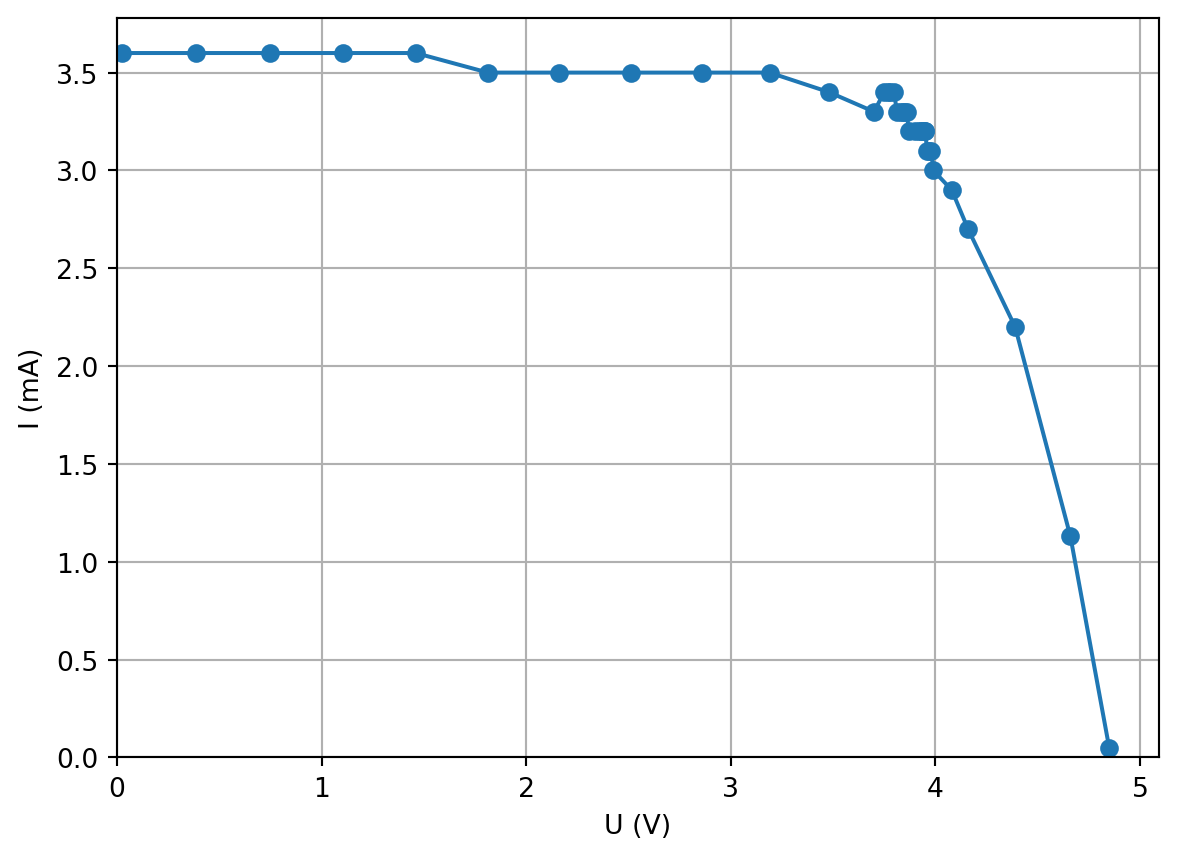
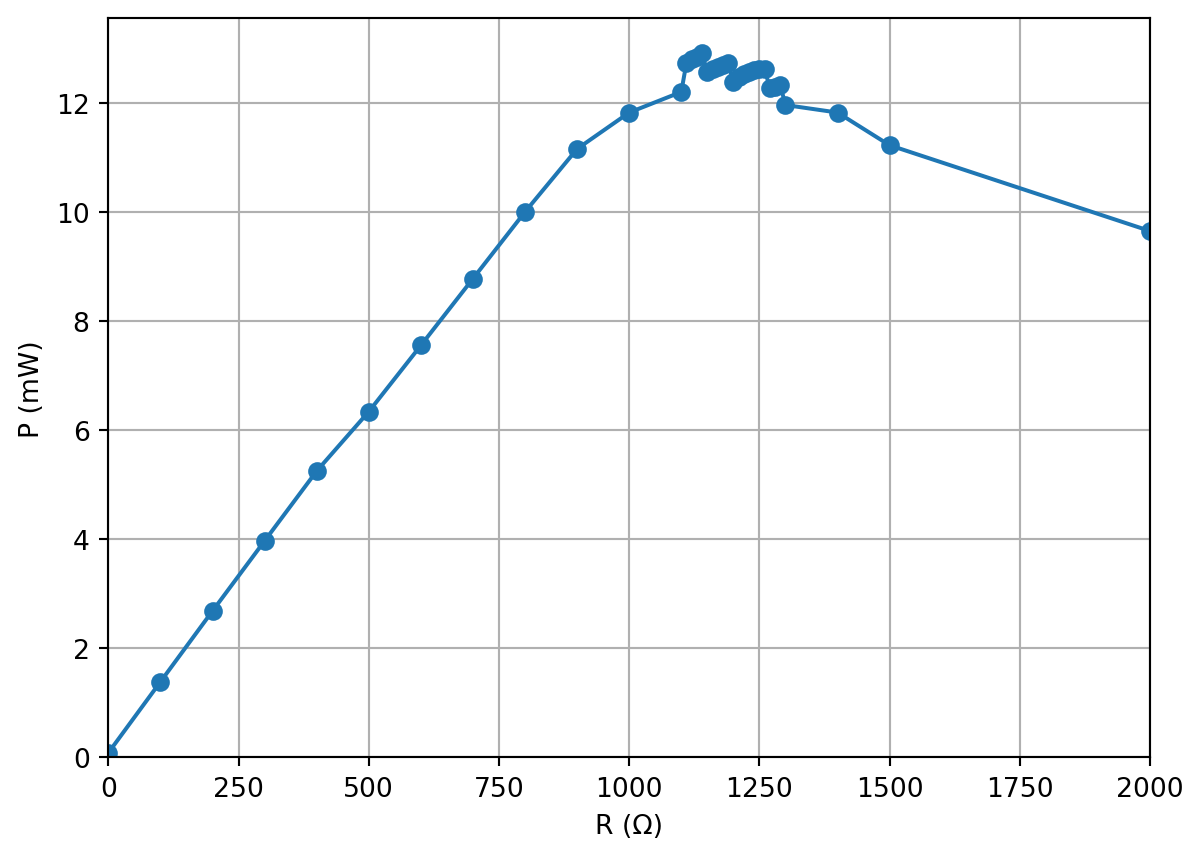
Complex side by side. (Figure 2, Figure 2 (a), Figure 2 (b))

Code
import numpy as np
import math
from IPython.display import Markdown, display
from tabulate import tabulate
import matplotlib.pyplot as plt

R = np.array([0,100,200,300,400,500,600,700,800,900,1000,
1100,1110,1120,1130,1140,1150,1160,1170,1180,1190,
1200,1210,1220,1230,1240,1250,1260,1270,1280,1290,
1300,1400,1500,2000,4000,math.inf])
U = np.array([24.2E-3, 0.386,0.747,1.104,1.460,1.813,2.16,2.51,2.86,3.19,3.48,
3.70,3.75,3.77,3.78,3.80,3.81,3.83,3.84,3.85,3.86,
3.87,3.90,3.92,3.93,3.94,3.95,3.95,3.96,3.97,3.98,
3.99,4.08,4.16,4.39,4.66,4.85])
I = np.array([3.6,3.6,3.6,3.6,3.6,3.5,3.5,3.5,3.5,3.5,3.4,
3.3,3.4,3.4,3.4,3.4,3.3,3.3,3.3,3.3,3.3,
3.2,3.2,3.2,3.2,3.2,3.2,3.2,3.1,3.1,3.1,
3.0,2.9,2.7,2.2,1.130,47.7E-3])
P = U*I

Code
fig, ax = plt.subplots()

ax.set_xlabel("U (V)")
ax.set_ylabel("I (mA)")

ax.plot(U, I, marker="o")
ax.grid(True)
ax.set_xlim(0)
ax.set_ylim(0)

plt.show()


fig, ax = plt.subplots()

ax.set_xlabel("R (Ω)")
ax.set_ylabel("P (mW)")

ax.plot(R, P, marker="o")
ax.grid(True)
ax.set_xlim((0, 2000))
ax.set_ylim(0)

plt.show()
(a) I-U
(b) P-R
Figure 2: solar panel

Subsection 2

Theorems

Theorem 1 (Test) This is a theorem. \[ \sum_{d \mid n} \varphi(d) = n \]

Proof. This is a proof ended with a display math. \[ \sum_{d \mid n} \mu(d) = [n=1] \]

Proof. This is a really really really really really really really really really really really really really really really really really really really really long proof.

Definition 1 This is a definition.

Example 1 (An example) This is an example.

Solution. This is the solution to the example.

Exercise 1 This is an exercise.

TipRemark

Remark. This is a remark of Exercise 1.

Lemma 1 This is a lemma.

Corollary 1 This is a corollary of Theorem 1.

Proposition 1 This is a proposition.

Conjecture 1 This is a conjecture.

References

[1]
Y. Taigman, M. Yang, M. Ranzato, and L. Wolf, “Closing the gap to human-level performance in face verification. deepface,” in Proceedings of the IEEE computer vision and pattern recognition (CVPR), p. 6.
[2]
M. Turk and A. Pentland, “Eigenfaces for recognition,” Journal of Cognitive Neuroscience, vol. 3, no. 1, pp. 71–86.